
Log House Rocket Man
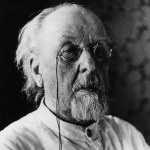

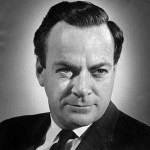


In The Loaded Tangent’s last post, a musical line of digression connected philosopher Thomas “Leviathan” Hobbes to the Russian Futurists (both the early 20th Century literary/arts movement and the same-named band from Toronto), and it’s to Russia we return here, via American engineer K. Eric Drexler.
Drexler is a fascinating character – the world’s foremost expert on, and champion-in-chief of, molecular nanotechnology. While he appears to have borrowed his name from Ian Fleming’s unused stockpile of preposterous villains, his clipped intonation belongs to the school of Niles Crane, fictional brother of Frasier. He has the air of a weary genius, a man who has grown tired of defending his theories, and he sports a silvering beard.
As a summary of Drexler’s standing within his chosen field, this 2010 WSJ article holds up well. It reviews his laudable efforts to popularize and develop concepts first alluded to by Richard Feynman (pictured bottom left) in the landmark 1959 Caltech lecture, There’s Plenty of Room at the Bottom, and highlights the too-often blurred differences between common-or-garden commercial nanotech (which focuses on the chemistry/materials science of smart paints, fabrics, medicines and the like) and pure Drexlerian atomic-scale nanotech (a revolutionary branch of engineering which could transform what it means to be human).
On 10 November 2011, Drexler gave the Inaugural Lecture at the Oxford Martin Programme: Exploring a Timeless Landscape: Physical Law and the Future of Nanotechnology. To support a key thread within his argument – that well-established physical principles have historically defined the boundaries of “possibility space” into which great innovators have boldly stepped – he highlights the amazing career of rocketry pioneer, Konstantin Tsiolkovsky (1857-1935, top left).
Like Drexler, Tsiolkovsky received a fair degree of flack for his early theoretical and conceptual work, but was ultimately vindicated. He was honored as a Soviet hero and buried in state. Remarkably, Tsiolkovsky deduced the fundamentals of rocketry and space travel without ever leaving smalltown Russia. As Drexler puts it:
“He worked out the principles of rocket propulsion in space, space suits, closed ecological life support systems, and a range of other technologies that are central to the enterprise of taking human life and moving it into space . . . [and] he did this while living in a log house in rural Russia, south of Moscow, teaching [mathematics in] high school.”
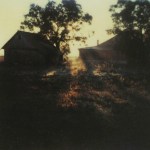
Drexler clearly feels a bond of kinship with Tsiolkovsky, who was known in the vicinity of Kaluga as something of an eccentric. The Russian believed humanity would one day colonize the Milky Way (bottom right), and was inspired by the science fiction of Jules Verne. In turn, he influenced a host of sci-fi writers, among them Stanislaw Lem (bottom middle), who name-checked Tsiolkovsky in Tales of Pirx the Pilot. The log house above (top middle) was photographed on Polaroid by Andrei Tarkovsky, who directed the brilliant 1972 movie version of Lem’s Solaris.
A generation down the line, at Pasadena’s Jet Propulsion Laboratory, American rocketry pioneer Jack Parsons (top right) – who “no doubt contacted Tsiolkovsky” according to Parsons’ biography Sex and Rockets – contributed his own fair share of eccentricity to the science of space flight. He pursued a keen interest in the occult, was hand-picked by Aleister Crowley to lead a Californian branch of the magical organisation, Ordo Templi Orientis, and knocked around with L. Ron Hubbard, pre-Scientology.
Parsons was killed, 17 June 1952, in an explosion at his home garage (possibly an accident, possibly at the hand of bent cop Earle Kynette, himself no stranger to explosive materials), not far from Caltech, where Feynman would give his groundbreaking lecture, There’s Plenty of Room at the Bottom . . .
Since this tangent is now wobbling around like a knuckleball, maybe it’s time to step back from the plate. This excellent video by Spanish band Dúo Cobra materializes for no apparent reason, along with 372 others, when “log house” is typed into Vimeo. It’s really rather good.




 The Loaded Tangent